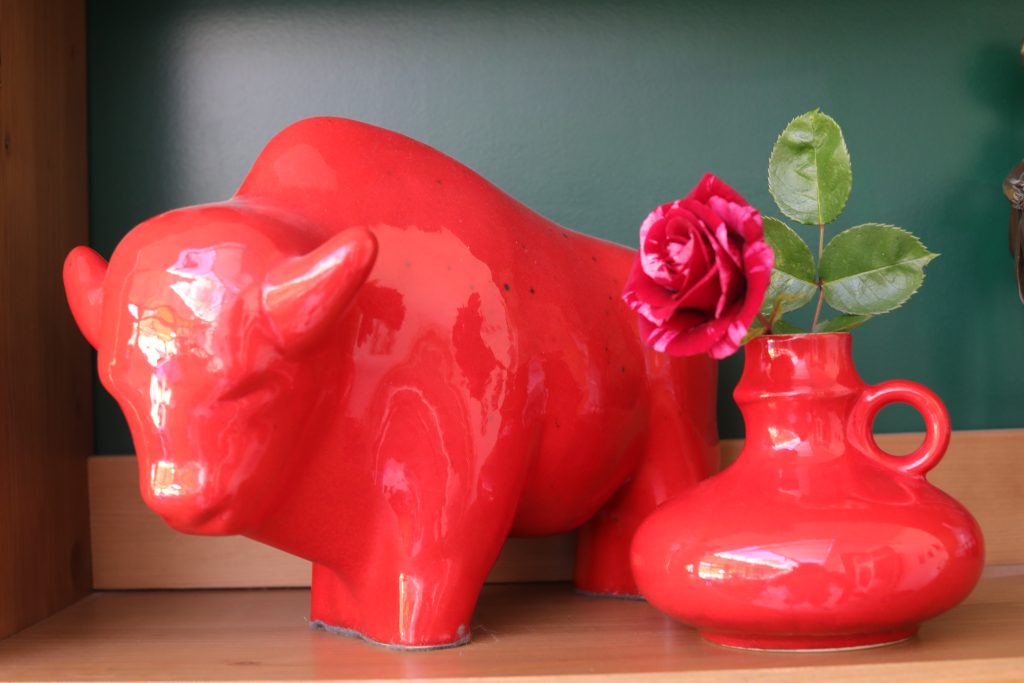
There are objects you buy because they are beautiful, and objects you collect because they tell a story. For me, vintage art pottery belongs firmly in the second category. Alongside photography, it has become one of my passions, and the Otto Gerharz bull captures exactly what fascinates me about it.
The bull is a striking ceramic sculpture: compact, powerful and unmistakably mid-century. Rather than aiming for realism, its form reduces the animal to its essence — strength, confidence and presence. That balance between abstraction and recognisability is one of the qualities I value most in vintage ceramics.
Otto Gerharz is especially interesting because of his expertise in ceramic glazes and glaze chemistry. In good art pottery, glaze is much more than colour. Its texture, depth and reaction during firing become part of the artistic expression. That means two examples of the same form can still have noticeably different characters.
The bull illustrates this beautifully. From a distance, you notice its silhouette. Up close, the glaze, firing marks and subtle irregularities begin to reveal how the piece was made. It invites you to keep looking.
That is also where my interest in pottery connects with photography. Both are fundamentally about observing light, form, texture and detail. With ceramics there is also the pleasure of investigation: turning a piece over, studying the base, searching for a model number or factory mark and trying to establish its origin.
Vintage West German pottery from the 1950s through the 1970s is particularly fascinating because it combines art, craftsmanship, industrial design and chemistry. Designers and manufacturers experimented boldly with shape and surface, producing everything from restrained modernism to the expressive glazes now often associated with Fat Lava.
I also enjoy the element of discovery. A remarkable piece can still turn up at a flea market, second-hand shop or online sale, sometimes without the seller knowing exactly what it is. Recognising something special is part of the pleasure.
For me, however, a collection is not primarily about value. It is about choosing objects that make me stop and look twice.
The Otto Gerharz bull does exactly that. It is more than decoration: it is a small piece of design history, craftsmanship and experimentation preserved in ceramic form. And that is precisely why collecting vintage art pottery has become one of my passions.